
First Published: October 16, 2026 Last Update: October 16, 2026
Vinyl vs wood fence is one of the most common choices homeowners weigh, and the honest answer is that each one wins on something different. Wood costs less upfront and looks like the real thing because it is, but it needs regular staining and eventually rots. Vinyl skips the maintenance, but it costs more to start with, can crack in hard cold, and doesn’t look like wood up close.
Here’s how the two compare on cost, upkeep, weather, and looks, plus a third option a lot of people don’t think about until they’ve replaced a fence once already.
Vinyl vs Wood Fence at a Glance
| Wood | Vinyl | |
|---|---|---|
| Upfront cost | Typically lower | Typically higher |
| Maintenance | Stain or seal on a schedule, replace boards as they go | Wash it occasionally |
| Rot and insects | Posts rot at the soil line, boards attract insects | Doesn’t rot or feed insects |
| Cold weather | Handles cold fine | Gets brittle and can crack on impact |
| Heat and sun | Fades toward gray without stain | Can soften or warp in high heat |
| Repairs | Swap a single board with basic tools | Often means replacing a whole section |
| Look | Real wood grain that weathers | Smooth plastic, limited textures and colors |
| Fire | Combustible | Combustible, melts and drips |
Wood Fences: Pros and Cons
Where wood wins
Wood is usually the cheapest fence to put in, it’s easy to cut and fit on uneven ground, and nothing looks more like a wood fence than real wood. When one board cracks, you replace one board.
Where wood falls short
Wood is a maintenance commitment. Stain or sealer has to go back on every few years or the boards gray, check, and split. The bigger problem is the posts. The few inches right at the soil line stay damp longer than anything else on the fence, and that’s where rot starts. In the Inland Northwest, fall rain and spring snowmelt keep the ground wet for months, so it doesn’t take long. Swapping in steel posts helps, which we cover in wood fence with metal posts, but the boards are still wood.
Vinyl Fences: Pros and Cons
Where vinyl wins
Vinyl doesn’t rot, doesn’t need paint or stain, and doesn’t attract termites or carpenter ants. A hose and some soap is about all the upkeep it asks for, which is the main reason people pay more for it.
Where vinyl falls short
Vinyl gets brittle in hard cold, so a hit from a snowblower, a ball, or a falling branch in January can crack a panel that would have flexed in summer. On the other end, it can soften in high heat. Repairs are harder too, since sections are made to fit together and a cracked panel often means replacing the whole section. And while some vinyl is embossed with a grain, it reads as plastic up close.
What About Fire?
Neither one is a good choice next to a house in wildfire country. Wood burns, and vinyl melts and drips. A fence that catches can carry fire straight to your siding, which is why wildfire programs recommend noncombustible fencing within five feet of a building. We explain how that happens in are wood fences a fire hazard, and CAL FIRE’s home hardening guidance covers why fences attached to a house matter so much.
The Option Most People Don’t Consider: Steel That Looks Like Wood
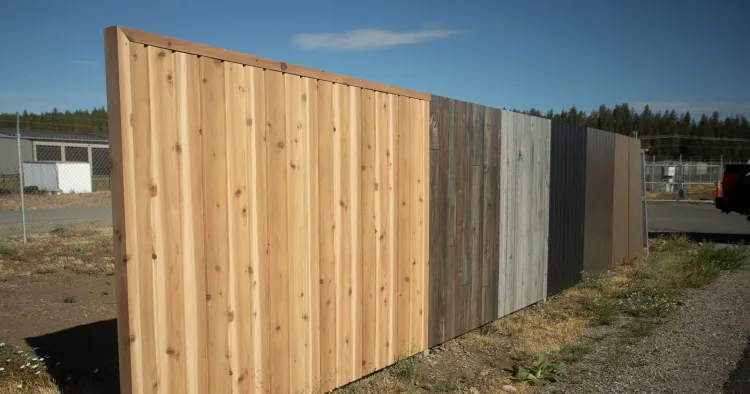
If you like the look of wood but don’t want the upkeep, and vinyl’s look or cold-weather cracking puts you off, a steel fence with a wood-grain finish splits the difference.
Every Metal America fence is built entirely from steel: square tube posts cemented into the ground, rolled steel panels, and a factory-applied finish. The panels mount to a 2.5-inch square tube steel post and frame system, and the fence is engineered to withstand 115 mph wind shear. The finish carries a warranty of up to 40 years, and there’s no painting, staining, or sealing.
The wood-grain prints are made from digitally enhanced scans of real wood, in finishes like Smooth Cedar, Barnwood, Walnut, and Burnt Wood Charcoal, and they go on both sides of the panel. Steel doesn’t rot, doesn’t crack in the cold, and it’s non-combustible. Our metal fence that looks like wood buyer’s guide covers the full lineup, and metal fence vs. wood fence compares the long-term costs.
Which Fence Should You Choose?
Choose wood if:
- Upfront cost is the deciding factor.
- You want real wood and don’t mind staining it.
- Your lot is uneven and you want something easy to cut and fit on site.
Choose vinyl if:
- You want low maintenance and you’re fine with a smooth, uniform look.
- Your winters are mild enough that brittle panels aren’t a big worry.
Choose steel if:
- You want the wood look without the upkeep.
- You get real winters, real wind, or real wildfire risk.
- You want the fence to look the same in 20 years as it does the day it goes in.
Whatever you pick, post spacing matters. See how far apart fence posts should be for each fence type.
FAQ
Is vinyl or wood fence cheaper?
Wood is usually cheaper to install. Once you add years of staining and board replacements, the gap narrows.
Does a vinyl fence crack in cold weather?
It can. Vinyl gets less flexible as it gets colder, so an impact in freezing weather is more likely to crack it.
Which fence is better for privacy, vinyl or wood?
Both make good solid privacy fences. Wood can shrink and leave small gaps between boards over time, while vinyl panels stay tight.
Is vinyl or wood better in wildfire areas?
Neither. Both are combustible. A noncombustible fence like steel is the safer choice near a house.
The Bottom Line
In the vinyl vs wood fence decision, wood wins on upfront cost and real-wood looks, and vinyl wins on low maintenance. Both have weak spots in Pacific Northwest weather, and both burn. If you want the wood look with none of the upkeep, a wood-grain steel fence is worth pricing alongside them. Give us a call or request free samples and a quote, and you can see the finishes in person.
Get a Quote
Find the Best Panel for Your Next Project
Fill out the form below and our team will get back to you within 24 hours with pricing and availability.
E-mail
sales@metalamerica.com
Phone number
855-638-2587