
First Published: October 6, 2026 Last Update: October 6, 2026
A 4/12 pitch in degrees is 18.43. That’s the whole answer: a roof that rises 4 inches for every 12 inches of horizontal run sits at an angle of about 18.4 degrees from flat. If you’re setting a miter saw, a bracket, or a solar mount, 18.5 degrees is close enough for most work.
The rest of this page shows where that number comes from, gives you a chart for the other common pitches, and covers what a 4/12 slope means when you’re putting metal panels on it.
How to Convert 4/12 Pitch in Degrees
Pitch is a ratio of rise over run. Degrees are an angle. To get from one to the other, you take the inverse tangent (arctan) of rise divided by run:
Angle = arctan(rise ÷ run) = arctan(4 ÷ 12) = arctan(0.3333) = 18.43 degrees
On a phone calculator, turn it sideways for scientific mode, type 4 ÷ 12, then hit the tan-1 key. Make sure it’s set to degrees, not radians.
Two mix-ups come up a lot:
- 4/12 isn’t 4 degrees. A 4 degree roof is a bit under 1/12, which is nearly flat.
- 4/12 isn’t 33 degrees. It’s a 33.3 percent grade, because 4 divided by 12 is 0.333. Percent grade and degrees are different measurements.
You’ll also see it written as 4:12 or “4 in 12”. They all mean the same roof.
Roof Pitch to Degrees Chart
Here’s 4/12 next to the other pitches you’re likely to run into.
| Pitch | Degrees | Percent grade |
|---|---|---|
| 1/12 | 4.76 | 8.3% |
| 2/12 | 9.46 | 16.7% |
| 3/12 | 14.04 | 25% |
| 4/12 | 18.43 | 33.3% |
| 5/12 | 22.62 | 41.7% |
| 6/12 | 26.57 | 50% |
| 7/12 | 30.26 | 58.3% |
| 8/12 | 33.69 | 66.7% |
| 9/12 | 36.87 | 75% |
| 10/12 | 39.81 | 83.3% |
| 12/12 | 45.00 | 100% |
How to Check Whether Your Roof Is a 4/12
You don’t need to get on the roof. From the attic or at a gable end, hold a level against the underside of a rafter so it reads level, mark 12 inches along the level, and measure straight up from that mark to the rafter. If you get 4 inches, it’s a 4/12. A digital angle finder or a phone level app laid on the rafter should read right around 18.4 degrees.
What a 4/12 Pitch Means for a Metal Roof
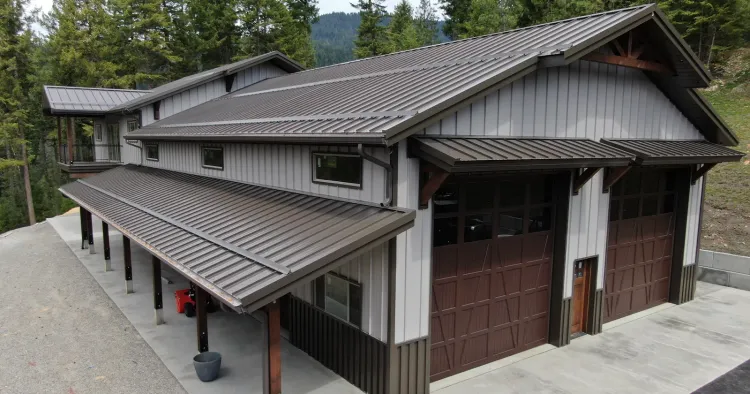
A 4/12 is one of the most common slopes on houses, shops, and pole barns, and it’s a comfortable one for metal.
It clears the code minimums for metal panels
The International Residential Code sets minimum slopes for metal roof panels in section R905.10.2: 3/12 for lapped, nonsoldered seam panels without lap sealant, 1/2 in 12 for the same panels with lap sealant, and 1/4 in 12 for standing seam. A 4/12 roof sits above all three.
That means both families of panel are on the table: exposed fastener profiles like Tuff Rib and PBR, and concealed fastener standing seam. The panel maker’s own published minimum is what governs your install, so check it for the profile you pick. Our guide to the minimum slope for a metal roof walks through it, and the standing seam vs exposed fastener comparison covers how to choose between the two.
It adds about 5 percent to your panel order
A sloped roof has more surface than the footprint under it. At 4/12, the slope multiplier is 1.054, so a simple gable covering 1,000 square feet of footprint (overhangs included) has about 1,054 square feet of roof surface.
The same math gives you panel length. A rafter covering 12 feet of horizontal run at 4/12 is about 12.65 feet long, or 12 feet 8 inches before you add any overhang. Since custom length metal roofing panels are cut to your measurements, measure the real roof instead of relying on the math alone.
It’s the top of the “low-slope” range for safety rules
OSHA’s construction standard defines a low-slope roof as one with a slope of 4 in 12 or less. Anything steeper is a steep roof with different fall protection requirements. Plenty of roofers consider a 4/12 walkable, but painted steel is slick when it’s wet, frosty, or dusty, so treat it with the same respect you’d give a steeper roof.
Snow slides, but slowly
In the Pacific Northwest, snow is the other thing pitch changes. A smooth metal roof at 18 degrees will shed snow, but it tends to hold a load for a while and then let go in sheets once the sun warms the panels. If that slide would land on a walkway, a deck, or a lower roof, plan for it. Our article on snow guards for metal roofs covers when they’re worth adding.
Whatever the slope, what goes under the panels matters too. See our guide to metal roofing underlayment for the options.
FAQ
What is a 4 12 pitch in degrees?
18.43 degrees. “4 12”, “4/12”, and “4:12” are three ways of writing the same slope: 4 inches of rise for every 12 inches of run.
Is a 4/12 pitch steep enough for a metal roof?
Yes. It’s above the code minimums for both lapped exposed fastener panels and standing seam. Confirm the published minimum for the specific panel you’re buying.
What is a 4/12 pitch as a percentage?
33.3 percent. Divide rise by run (4 ÷ 12 = 0.333) and multiply by 100.
What angle do I cut a rafter for a 4/12 roof?
The plumb cut at the ridge is 18.43 degrees off square, which is the roof angle itself. A framing square set to 4 and 12 marks the same line without any math.
The Bottom Line
A 4/12 pitch is 18.43 degrees and a 33.3 percent grade. It’s a common, easy slope for metal: steep enough for any panel profile, shallow enough to work on carefully, and it adds only about 5 percent to your roof area.
If you’re pricing metal roofing panels for a 4/12 roof, give us a call or request a quote. We’ll help you match a profile and gauge to the building, and we’re happy to send free color samples.
Get a Quote
Find the Best Panel for Your Next Project
Fill out the form below and our team will get back to you within 24 hours with pricing and availability.
E-mail
sales@metalamerica.com
Phone number
855-638-2587